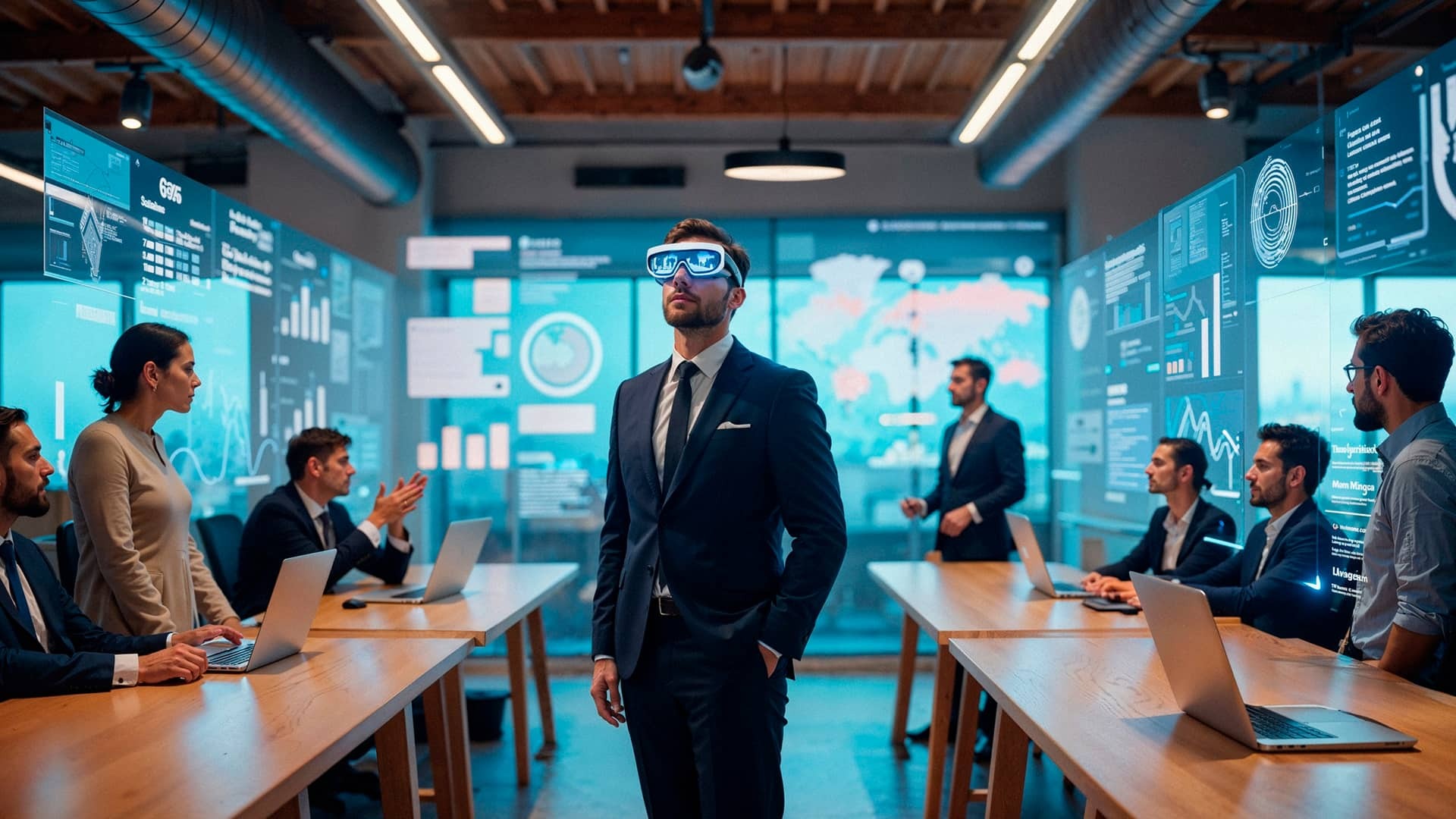
The Corporate Metaverse is like the digital office of the future. Businesses are entering a new phase with the internet undergoing transformations and evolution. It will alter how people communicate, collaborate, and maintain relationships. However, what is it precisely, how does it work, and why is it significant to you?
Imagine being able to work from home. In a virtual environment, you put on a headset or open your laptop, go into a virtual workplace, sit with your teammates, attend meetings, pick up new skills, and even engage in informal conversation. The Corporate Metaverse is the name given to this emerging digital workplace.
It used to sound like science fiction, but it is now increasingly becoming true.
The corporate metaverse represents a fundamental shift in the way work is done. It makes digital work more human and interactive and unites people beyond geographical boundaries.
The advantages are clear, although with the challenges. The corporate metaverse can enhance workplace culture, learning, and cooperation with careful application, appropriate training, and balanced adoption.
It might not seem new or complicated in the years to come. Rather, it can just seem like another organic location where work is done, similar to modern offices, emails, and video chats.
What is The Metaverse?
We need to understand the term “metaverse” in order to fully understand the corporate metaverse.
The metaverse is a technologically created virtual world where people may interact and meet as they would in real life. People are represented by digital characters known as avatars rather than physical bodies.
Within the metaverse:
- Walking, talking, sitting, and interacting are all possible.
- You feel present in a digital setting,
- You are a part of the surroundings instead of only viewing a screen.
Consider the metaverse as the next stage of the internet…
Important Figures That Show the Metaverse’s Scale
The expansion of the metaverse is not simply predicated on theories and predictions. Strong statistics and professional research make it abundantly evident how large and significant this area is growing. It’s simpler to see why businesses are taking the corporate metaverse seriously when we put these numbers together.
An Opportunity worth Trillions of Dollars
By 2030, experts worldwide predict that the metaverse could develop into a huge business valued at between 8 trillion and 13 trillion US dollars. This implies that it could grow into one of the largest digital economies ever established.
Corporate Metaverse is more than just technology for businesses. It stands for innovative company strategies, innovative methods of operation, and enormous long-term growth prospects.
Billions of Daily Users Anticipated
According to research firms, a significant fraction of the world’s population will soon incorporate the metaverse into their daily lives. Experts predict that by 2026, a quarter of the global population may spend at least an hour each day in metaverse environments.
This might equate to over 2 billion daily users, demonstrating how the metaverse is evolving from a specialized concept to a widely used digital platform.
Quick Growth of VR Devices
The increasing use of hardware also contributes to the growth of the metaverse. Market research predicts that the number of virtual reality (VR) headsets worldwide is anticipated to reach 34 million units.
The Corporate Metaverse Explanation
When businesses use the metaverse for work-related purposes, it’s known as the corporate metaverse.
To put it simply:
Corporate metaverse refers to the use of virtual environments for training, meetings, office work, and teamwork.
Companies establish virtual offices where staff members can interact and collaborate more naturally, rather than relying just on emails, video calls, and chat messages.
Why Do Businesses Want to Use the Corporate Metaverse?
Workplace culture is rapidly evolving. Digital technologies, international teams, and remote work are now normal. This new method of working is ideal for the corporate metaverse.
Businesses are drawn to it because it benefits them:
- Bring distant workers closer.
- Boost international cooperation
- Cut back on office and travel expenses.
- Make work more interesting and relatable.
To put it simply, businesses can operate more effectively, quickly, and intelligently due to this technology.
How Does the Corporate Metaverse Operate?
To make this understandable to everyone, let’s break it down into very simple steps.
Step 1: Beginning in the Virtual World
Workers enter a virtual environment created by the organization using a computer, laptop, or occasionally a virtual reality headset. This area appears to be a training facility, meeting room, or office.
Step 2: Making an Avatar
An avatar is a digital representation of each employee. Compared to standard video calls, avatars can convey emotions, gestures, and movements, making conversation feel more authentic.
Step 3: Working together
Employees can communicate, share screens, share ideas, and collaborate in the virtual environment. People feel present together, which makes even informal interactions feel more natural.
Common Uses of the Corporate Metaverse
The corporate metaverse is currently being applied in numerous real-world contexts.
1. Virtual Meetings
Video calls don’t feel as participatory as virtual meetings in the metaverse. People converse organically while seated around a table and viewing each other’s avatars.
Employee engagement and attentiveness are increased when they feel as though they are in the same room rather than staring at tiny boxes on a computer.
2. Training for Workers
The corporate metaverse greatly increases the effectiveness of training. Workers practice instead of just listening.
For instance:
- Safety protocols can be taught to factory personnel.
- Doctors can practice medical situations.
- Teams in charge of customer care can deal with fictitious clients.
- This practical learning enhances understanding and self-assurance.
The advantages of the corporate metaverse
Both businesses and employees can profit greatly from the corporate metaverse.
Advantages for Businesses
Businesses increase teamwork while saving money on training, office space, and travel. Teams feel more unified, and meetings become more productive.
Benefits for Workers
Flexible work schedules, interesting workplaces, and improved work-life balance are all appreciated by employees. They are more engaged with the business culture and feel less alone.
Will Physical Offices Be Replaced by the Corporate Metaverse?
No, offices are not entirely being replaced by the corporate metaverse.
It is viewed by most businesses as a support system. Virtual places, remote work, and physical offices will all coexist.
The metaverse only offers an additional choice for where and how work can be done.
Corporate Metaverse Challenges
The corporate metaverse has challenges, much like any new technology.
Cost and Technology
Purchasing equipment and setting up virtual environments can be costly, particularly initially.
Learning and comfort
It can take some time for some employees to get used to it. Businesses need to offer adequate assistance and training.
Security and Privacy
Virtual environments need to be safe. It is crucial to protect employee privacy and business data.
Balance and Health
Long-term use of virtual worlds might be uncomfortable. Rules for healthy usage are essential.
Is the Corporate Metaverse Exclusive to Large Organizations?
Not at all. Although big corporations were the first to do so, smaller organizations are increasingly exploring it as well.
As technology advances:
- Expenses are going down.
- Tools are getting simpler to use.
- The obstacles to entry are decreasing.
In the future, simple corporate metaverse systems might be used by even small teams.
Let’s understand this with a basic real-world example;
Consider a business that employs people in Europe, the US, and India. Everyone meets every day in a virtual office rather than exchanging countless emails and making late-night video calls.
Despite their distance, they feel connected as they sit together and exchange ideas on a digital board. This is an example of the corporate metaverse.
The Future of Corporate Metaverse
The corporate metaverse is still evolving. In the upcoming years, we might witness better integration with everyday work tools, more lifelike avatars, and simpler access without headsets.
Virtual offices might eventually become as normal as email and video conversations.
The corporate metaverse stands for a fresh approach to cooperation and work.
Company Culture and the Corporate Metaverse
Company culture is one significant area where the corporate metaverse has an impact. Employees who work remotely in the traditional sense frequently feel cut off from the company. They complete tasks but lose out on informal discussions, mutual respect, and a feeling of community.
The gap is lessened by the corporate metaverse. Employees can get together informally, celebrate birthdays, welcome new team members, and take part in team activities in virtual offices. Stronger bonds and trust are fostered by these little exchanges.
Eventually, this results in:
- Better collaboration
- Increased motivation among employees
- A deeper emotional bond with the organization
The metaverse facilitates the digital recreation of shared experiences, which contribute to the development of a healthy culture.
Additionally, several businesses are experimenting with hiring and recruiting through the metaverse. Candidates can participate in group activities, meet team members, and enter a virtual office in place of traditional interviews.
This helps businesses in comprehending:
- Candidates’ communication style
- How do they resolve issues?
- How they collaborate in groups
Candidates also gain a deeper comprehension of the workplace at the same time. Both parties make better recruiting judgments as a result.
To put it simply, it makes individuals feel more connected, collaborate better, and learn more efficiently. To use or comprehend it, you don’t have to be an expert in technology.
The corporate metaverse may soon become a standard feature of daily work life, similar to many other digital technologies.